
The closed beta
You have been admitted to Brotto Cloud: the same extension, with our server running it instead of yours. This page is what that means in practice — what you get, what we ask of you, and exactly what we can see while it runs.
What you get
100 tasks a week, and the count resets every Monday. It is generous on purpose: the thing we are watching for is whether you come back and use it, and a cap low enough to interrupt somebody mid-week would be measuring the wrong thing.
No cap on how long a single task runs. If a job is going to take twenty minutes, it takes twenty minutes. A per-task spend ceiling is planned, not on today: until it ships, a task spends whatever your provider charges for the tokens it uses, with no Brotto-imposed ceiling. If you want a hard limit now, run it yourself and use your provider's own budget controls.
You still bring your own model key, so the page you are looking at goes to your provider and not to us. The same providers the self-hosted install supports.
Add Brotto to Chrome, sign in with your email, get a six-digit code, and ask for something in the tab you are already signed in to. That is the whole setup.
What we ask of you
Two things, and they are the whole ask.
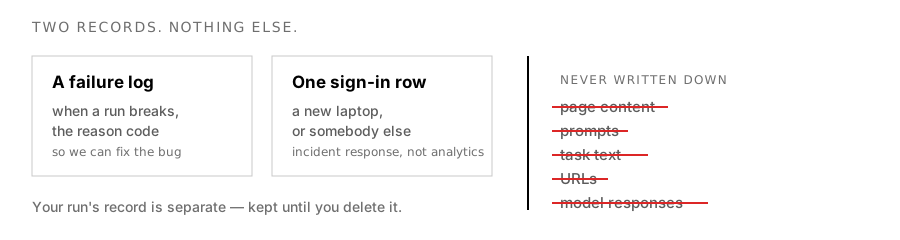
Tell us when it breaks. When a run fails, the panel offers to send us the reason code and your account id. Refusing it costs you nothing except that we find out about the bug from somebody else.
Just reply. The address we invited is a mailbox somebody reads. A sentence about what you tried and what happened is worth more to us than any form.
What we can see
Page observations pass through a machine we run, for as long as the task is in flight. That is inherent to how the agent works — it is true of a self-hosted install too, where the machine is yours and there is no operator on the other end. What differs here is that the operator is us, and it is worth being exact about what that means.
Still there when you come back
A run's record stays — its prompts, its actions, its timings — so the task is there when you return to it. Never the page text, which is not written down at all.
Stripped before it goes further
Credentials, API keys, bearer tokens and card numbers are redacted in code before page text reaches your model provider. The policy says exactly what it covers.
Nothing sold, nothing profiled
No advertising, nothing sold or shared. We do take product analytics — counts of whether people can run a task, not what the task was. A failure log and one record per sign-in exist too; Privacy lists every field.
Yours to delete
Every session has a delete button in the panel. You can also leave, at any time, by replying to the invitation — there is nothing to uninstall first, and writing back is the whole exit.
All of this is written out in full, for both deployments, in Privacy and Security.
When it ends
There is no announced end date and nothing is scheduled. If that changes, we will write to the address we invited and say what happens next. Self-hosting is not part of the beta: free, permanent, Apache 2.0, and yours to run.
About the beta, and the invite list · Privacy · Back to the front page